Choosing a golf head cover looks like a style decision and is really a materials decision. The fabric wrapped around a driver crown determines whether the cover shrugs off a rain delay or soaks through, whether a logo reads as a crisp full-color mark or a simple knitted motif, and whether the cover outlives the club or gets replaced every couple of seasons. For anyone ordering covers in quantity, the material sets the ceiling on both durability and how a brand looks on the bag, so it is worth understanding what each one actually does before picking a look.
What a head cover has to protect against
Modern woods make the case for covers on their own. Driver crowns are now thin carbon composite, and the paint and clearcoat on a premium head scratch easily when clubs knock together in a bag or ride around in a cart. A head cover is guarding against three separate things: abrasion from clubs and bag dividers rubbing the crown, impact from heads clacking together over a round, and weather, meaning rain running down into the bag and pooling around the hosel. Different materials handle those three jobs very differently, and no single fabric is best at all three at once. That trade-off, more than color or pom-poms, is what should drive the choice.
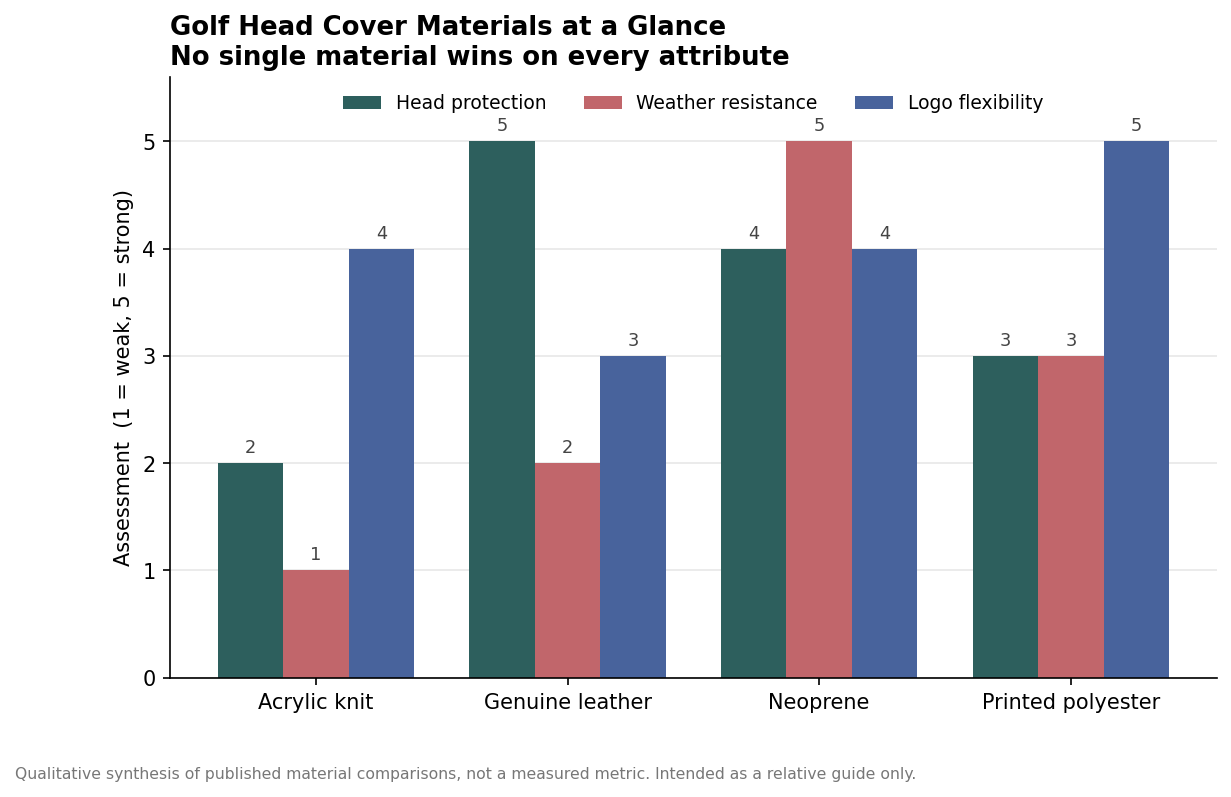
The chart above is a relative guide, not a lab measurement, but it captures the core tension: the material that protects best against knocks is not the one that keeps water out, and the one that carries a full-color logo most faithfully is not the most rugged. Deciding which of those attributes matters most for your use is the whole game.
Acrylic knit: the classic look
Knit covers, almost always acrylic or an acrylic-wool blend, are the retro sock-style pieces with a pom on top. Their strength is character and decoration flexibility: patterns, stripes, and numbers can be knitted directly into the fabric using intarsia, so a fairway set can carry a bold 3, 5, and 7 or a repeating logo motif with no printing at all. They stretch to fit a range of head shapes, breathe well, and are light. The weakness is protection. A knit cover is a soft barrier against scratches and offers almost no rain resistance and only modest cushioning against hard impacts. It also has the shortest service life of the common materials, typically a year or two of regular play before the knit thins or the pom frays. For a lifestyle brand, a members’ gift with a vintage feel, or a bag that lives mostly indoors, knit is a strong look; for genuine weather protection it is the weakest option.
Leather and synthetic leather
Leather is the premium end. Genuine leather has excellent abrasion resistance, real heft against knocks, and by a wide margin the longest life of any option, often five to ten years when it is cared for. Personalization is done through embossing or debossing and stitched detailing rather than printing, which gives a restrained, high-end result but does not reproduce fine full-color artwork. The catch is that genuine leather dislikes water: it stains, stiffens, and needs occasional conditioning, so it is happiest on a bag that gets wiped down and stored properly. Synthetic leather, usually a polyurethane coating on a fabric backing, keeps most of the leather look while tolerating rain far better and accepting embroidery and print more readily. For a corporate gift program where the cover represents the brand for years, leather or good synthetic leather is the material that holds up to the expectation.
Neoprene and printed polyester: the workhorses for logos
When the priority is a clean logo produced in volume, neoprene and printed polyester earn their place. Neoprene is a closed-cell foam that is genuinely waterproof and adds real padding around the head, giving it the best combination of weather resistance and impact protection of the everyday materials, with a service life in the three-to-six-year range. It takes printing, embroidery, and embossed or jacquard patterns well, which is why it dominates magnetic mallet putter covers. Printed polyester, decorated by dye sublimation, is the one material that reproduces a full-color logo edge to edge with photographic fidelity, making it the default for event tee gifts and any design with gradients or many colors. Its protection is moderate and weather resistance depends on a PU coating, but for a large branded run where the artwork is the point, nothing matches its print quality per dollar.
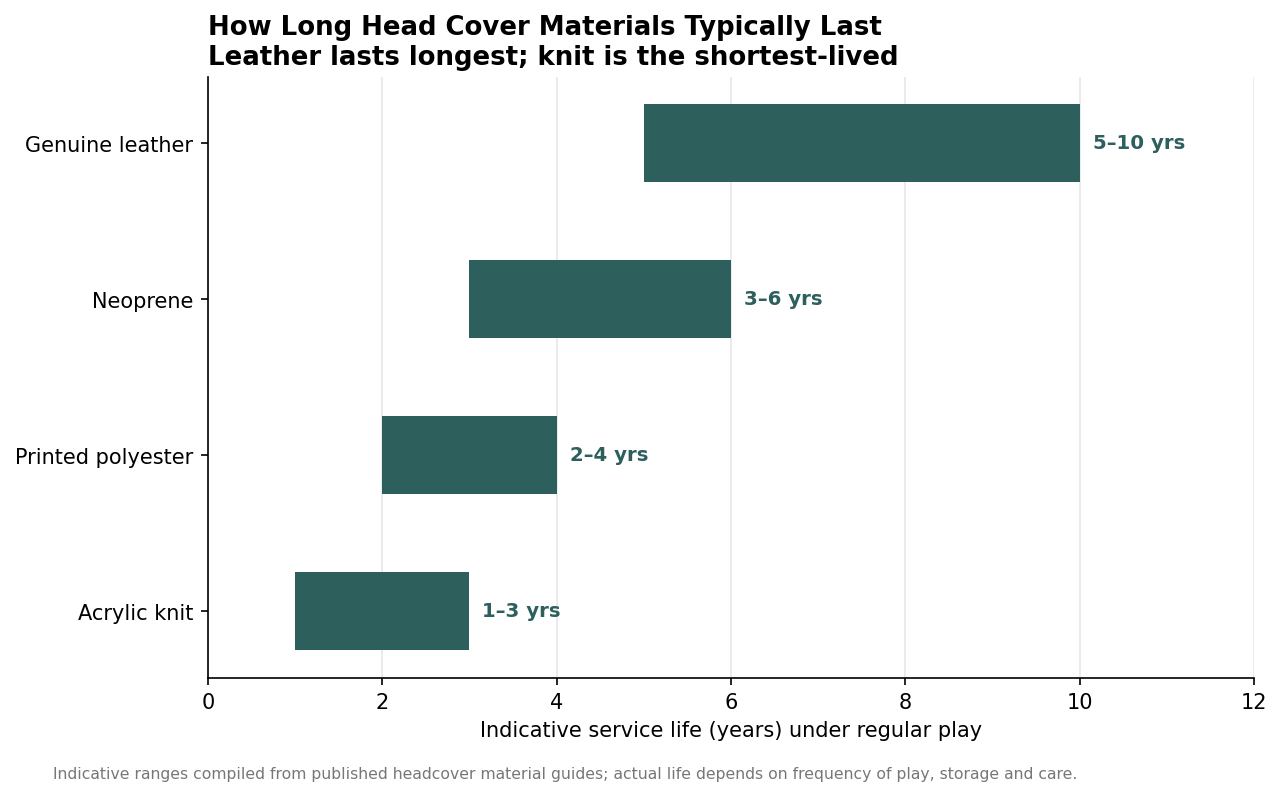
The service-life ranges above are indicative rather than guarantees, and real longevity swings with how often the clubs are played, how they are stored, and whether covers are cleaned. Still, the ordering is consistent across sources: leather lasts longest, knit the shortest, with neoprene and polyester in between.
Matching the material to the order
Start from the club and the use. A driver cover needs to accommodate a head up to the 460cc legal maximum, so a fitted leather or synthetic cover should be cut for that volume while a stretch knit or neoprene sock will flex to fit. Fairway and hybrid covers benefit from knitted or printed numbers so players grab the right club, and hybrids in particular vary enough in shape that a stretch material fits a mixed set more forgivingly. Putter covers, especially mallets, are where neoprene with a magnetic closure has become standard because the shape is boxy and the closure has to be quick and secure. For the order itself, match material to intent: a single high-value gift leans leather, a weatherproof daily set leans neoprene, and a large event or promotional run with detailed artwork leans printed polyester. Sort out that fabric-to-purpose match first, and the color, closure, and decoration decisions fall into place around it rather than fighting it.